
How to Bluff in Poker: Mastering the Art of Deception
Mastering the art of deception is what separates average players from true professionals at the tables. Whether you are playing a casual home game, competing in top UK poker rooms, or testing your skills online at the Best Poker Sites, knowing how to manipulate your opponents’ perceptions is a vital skill. Bluffing is not just about keeping a straight face; it requires a deep understanding of timing, table dynamics, and basic maths. When executed correctly, a well-timed bluff can win you pots that your cards simply do not deserve.
This comprehensive guide covers everything you need to know about pulling off the perfect bluff in poker. We will explore the fundamental mechanics of deception, outline the specific situations where a bluff is most profitable, and highlight the crucial moments when you should simply fold your hand. By the end of this article, you will have a solid framework for exploiting your opponents’ weaknesses and increasing your overall win rate.
What is a poker bluff?
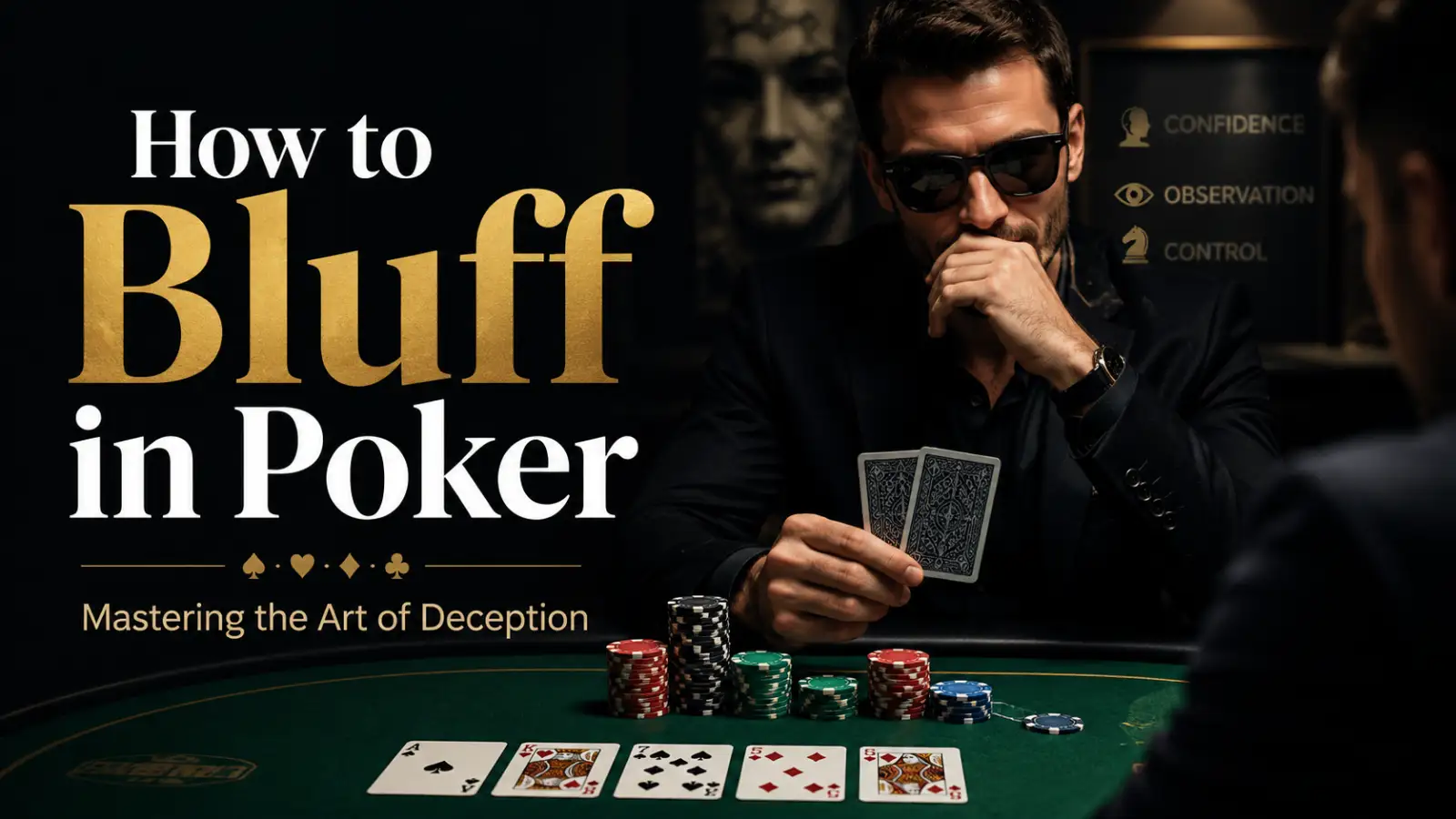
At its core, a bluff in poker is an aggressive action taken with a weak hand that has little to no chance of winning if the cards go to a showdown. 🃏 The primary objective is to force your opponents to fold a mathematically superior hand. You are essentially telling a believable story with your chips, convincing the table that you hold the nuts when you actually hold nothing.
Successful bluffing relies heavily on the concept of “fold equity,” which is the additional value you gain in a hand based on the probability that your opponent will fold to your bet. When playing in competitive UK card rooms or high-stakes online cash games, mastering fold equity is essential for long-term profitability. You cannot simply wait for premium pocket cards to build your chip stack. If you never bluff, observant players will realise you only bet with the goods and will comfortably fold, starving you of action.
Understanding the psychology behind the play is just as crucial as the underlying maths. A bluff preys on an opponent’s fear of losing chips to a stronger hand. To execute it perfectly, your betting sequence must align logically with the community cards on the board, making your deceptive narrative indistinguishable from the truth.



Types of bluffs in poker
Not all deception is created equal at the poker table. 🎭 Understanding the distinct categories of bluffs allows you to deploy the right strategy based on the board texture and your opponents’ tendencies.
Here is a breakdown of the most common bluffing techniques you will encounter:
Type of Bluff | Description | Risk Level |
|---|---|---|
Stone-Cold Bluff | Betting with absolute air, meaning your hand has zero equity and relies entirely on your opponent folding to win the pot. | Extremely High |
Continuation Bet (C-Bet) | Taking the lead on the flop after being the pre-flop aggressor, maintaining your narrative of strength regardless of whether the flop helped you. | Low to Medium |
Opportunistic Bluff | Attacking the pot when the board texture is dry and all opponents have shown weakness by checking to you. | Medium |
Semi-Bluff | Betting with a drawing hand that is currently weak but has a mathematical chance to improve to the best hand on future streets. | Medium |
Professional players rarely rely on the stone-cold bluff, as it carries immense risk with no backup plan. Instead, they build their strategy around continuation bets and opportunistic plays. By carefully selecting which type of bluff to use, you can minimise your exposure while maximising your chances of scooping the pot uncontested.
When to bluff
Timing is arguably the single most important factor in a successful bluff. ⏱️ Executing a bluff at the wrong moment against the wrong player is a guaranteed way to bleed your bankroll. You must continuously analyse the table dynamics to pinpoint profitable situations.
Here are the optimal conditions for attempting a bluff:
- You have late position at the table, allowing you to gauge your opponents’ weakness through their checks before you commit any chips.
- Your table image is currently tight and conservative, meaning your sudden aggression will be highly respected by the rest of the players.
- The board texture is coordinated with scare cards, such as a potential four-card flush or a paired board, giving you a credible story to tell.
- You are playing heads-up against a single opponent, as bluffing into multi-way pots exponentially increases the likelihood that someone has a hand they refuse to fold.
- Your opponent has a proven track record of playing “fit or fold” poker, meaning they readily surrender the pot if they fail to connect with the flop.
Conversely, you must constantly monitor stack sizes before making a move. Attempting to bluff an opponent who is extremely short-stacked is foolish, as they are often pot-committed and mathematically obliged to call your bet with any piece of the board.
Bluffing in different variants
While the underlying psychology remains the same, the mechanics of bluffing shift dramatically depending on the specific poker variant you are playing. 🎲 What works perfectly in a standard UK pub game might be disastrous in a specialist online tournament.
In No-Limit Texas Hold’em, the ability to bet your entire stack at any moment gives you maximum leverage to pressure your opponents. The presence of hidden hole cards allows for wider perceived ranges, making it the most bluff-friendly variant. However, in Limit Hold’em, your bet sizing is restricted, meaning fold equity is significantly reduced and pure bluffs rarely succeed against seasoned players.
Pot-Limit Omaha (PLO) is a completely different beast when it comes to deception. Because players receive four hole cards, the average winning hand at showdown is remarkably strong. Bluffs in PLO must be highly calculated, heavily reliant on having “blockers” — cards in your hand that make it mathematically impossible for your opponent to hold the nuts.
Short Deck Hold’em (6+ Hold’em) also requires a drastic adjustment to your bluffing frequencies. With all cards below a six removed from the deck, draws hit much more frequently, and the relative value of hands changes entirely. In this high-action variant, you should heavily favour aggressive semi-bluffing with strong draws rather than relying on pure stone-cold bluffs.
The mathematics of bluffing
Before you push your chips into the middle, you need to understand the mathematical formula that determines if your bluff is inherently profitable. 🧮 The most critical concept is the break-even percentage, which tells you exactly how often your opponent needs to fold for your play to show a positive expected value. You calculate this using a simple equation based on the chips you are risking compared to the total reward.
The formula is Break-Even = Risk / Risk + Reward.
In this equation, the risk is your bet size, and the reward is the total pot size before your bet. If your estimated probability of an opponent folding is higher than this calculated break-even percentage, your bluff will mathematically print money over time. Understanding this prevents you from making massive overbets that require unrealistically high fold frequencies to succeed.
Here is a quick reference guide for common bet sizes and their required success rates:
Bet Size | Risk vs. Reward Ratio | Required Fold Frequency | Profitability Scenario |
|---|---|---|---|
Quarter pot | 1 to 4 | 20% | Highly profitable against weak ranges |
Half pot | 1 to 2 | 33% | Standard continuation bet sizing |
Full pot | 1 to 1 | 50% | Requires strong fold equity to work |
Double pot | 2 to 1 | 66% | Extreme risk used for maximum polarization |
Understanding card blockers
Another advanced concept that separates elite players from casual pub-game participants is the strategic use of card blockers. 🚫 A blocker is a specific card in your hole cards that makes it mathematically impossible, or at least highly unlikely, for your opponent to hold a premium winning hand. Incorporating blockers into your decision-making process drastically increases the success rate of your big river bluffs.
When you hold a relevant blocker, you are removing combinations of strong hands from your opponent’s perceived range. For example, if you hold the Ace of Spades on a board featuring three other spades, you have the ultimate blocker. You know with absolute certainty that no one else at the table holds the nut flush, making it incredibly easy to represent that exact hand with a large, aggressive bet.
Key principles for utilising blockers effectively:
- Pinpoint the exact cards that form the strongest possible hand on the current board texture.
- Prioritise bluffing when you hold the ace of the active flush suit.
- Avoid bluffing when you hold cards that block your opponent’s missed draws, as this increases the likelihood they hold a strong pair instead.
- Use intersecting straight blockers to represent the top end of a connected board.
- Remember that holding a single blocker in Pot-Limit Omaha is often less effective due to opponents having four hole cards.
How to bluff successfully
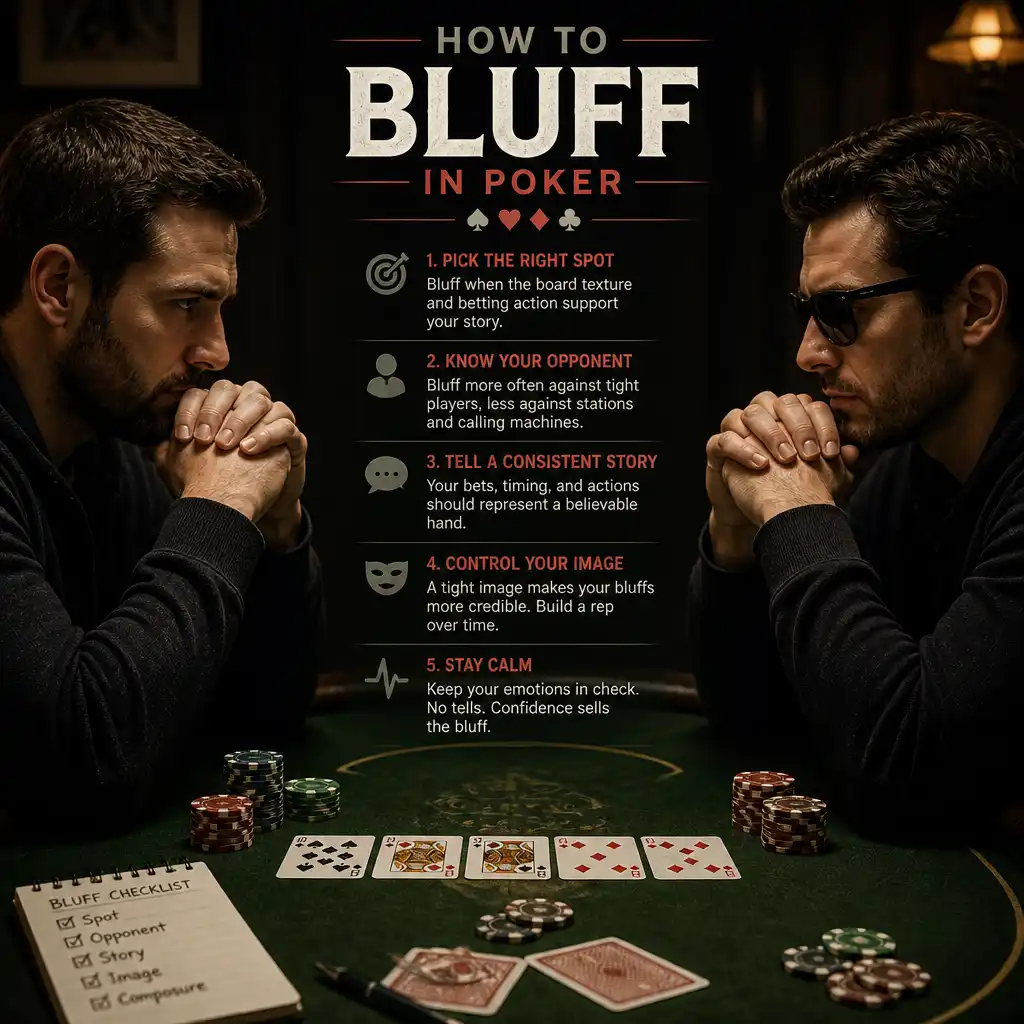
To pull off a convincing bluff, your actions must tell a logical and cohesive story from the pre-flop action all the way to the river. 📖 Randomly betting massive amounts of chips out of nowhere usually screams desperation rather than strength. Professional players carefully construct their betting lines to represent specific strong hands. Your bet sizing needs to be consistent with how you would play a genuine monster hand. If you only make large bets when you are bluffing, observant opponents will quickly exploit your strategy.
Key elements of a successful bluff include:
- Maintaining a consistent bet size to disguise your true holding and avoid giving away obvious patterns.
- Targeting the right opponents, specifically thinking players who are capable of folding a decent but non-premium hand.
- Utilising your positional advantage to act last, allowing you to gather maximum information before committing chips.
- Ensuring your story aligns with the community cards, such as representing a strong ace when an ace hits the flop after you raised pre-flop.
When not to bluff
Knowing when to keep your chips in your stack is just as vital as knowing when to push them into the middle. 🛑 There are specific scenarios where attempting a bluff is essentially throwing money away. The most common mistake amateur players make in UK card rooms is trying to bluff a “calling station.” These are recreational players who simply love to call bets regardless of the board texture or their actual hand strength. You cannot bluff a player who refuses to fold.
Avoid bluffing in these high-risk situations:
- Multi-way pots with three or more opponents, as the probability of someone holding a premium hand skyrockets.
- When an opponent is extremely short-stacked and mathematically committed to calling any bet.
- Micro-stakes online cash games, where players routinely call down with bottom pair just to see your hole cards.
- Against players visibly on tilt, as their emotional state makes them unpredictable and highly likely to make irrational hero calls.
Reading your opponents
A successful bluff requires a deep understanding of the players sitting across the felt from you. 👁️ You need to profile your opponents and categorise their playing styles to predict how they will react to aggression. Live poker in UK casinos offers the chance to pick up physical tells, such as nervous chip shuffling, shaking hands, or sudden changes in breathing. However, online poker relies entirely on betting patterns, action timing, and available HUD (Heads-Up Display) statistics.
Crucial indicators to watch for when profiling players:
- Sizing anomalies, where players use specific bet amounts for bluffs and completely different sizes for value bets.
- Timing tells online, such as an instant check, which often indicates weakness or a pre-selected auto-play setting.
- Posture changes at live tables, including players suddenly leaning forward or sitting rigidly when a strong card hits the board.
- Table chat and verbal cues, as players who suddenly become unusually talkative are often overcompensating for a weak hand.
Advanced semi-bluffing strategy
Instead of relying purely on fold equity, semi-bluffing gives you a mathematically sound backup plan. 📈 This technique involves betting aggressively with a drawing hand, such as a four-card flush or an open-ended straight draw. If your opponent folds, you win the pot immediately and secure uncontested chips. If they call, you still have a strong probability of hitting your outs on the turn or river to make the best hand.
Semi-bluffs are highly profitable because they combine two distinct ways to win the hand. This dual equity makes it much easier to commit chips to the pot compared to a stone-cold bluff with zero equity. Furthermore, semi-bluffing perfectly disguises the strength of your hand when you do eventually hit your draw. Opponents will often assume you missed a different draw or are still bluffing, leading them to pay you off handsomely on the river.
To maximise your semi-bluffing profitability, focus on draws with the highest number of outs. A combination draw, such as holding a pair alongside a flush draw, offers massive potential. The more ways you have to improve to the winning hand, the more aggressive you can afford to be with your betting strategy.
Responsible gambling
While mastering deception at the poker table is an exciting and profitable skill, it must always be balanced with strict responsible gambling practices. 🛡️ Poker can be a highly volatile game, and the psychological nature of bluffing can sometimes lead to emotional decision-making or “tilt” when a big play goes wrong. Protecting your bankroll and your mental well-being is the ultimate mark of a professional player.
If you are playing in the UK, whether online or at a local casino, there are numerous tools available to help you maintain control. Setting strict deposit limits, session time limits, and loss limits before you sit down to play ensures that a bad beat does not derail your finances. Always remember that poker should be treated as a form of entertainment first and foremost, never as a guaranteed way to make a living or recover previous losses.
Keep these responsible gaming principles in mind during every session:
- Never play with money that you cannot comfortably afford to lose, keeping your poker bankroll entirely separate from your living expenses.
- Walk away from the table if you feel frustrated, tired, or under the influence of alcohol, as these states severely impair your ability to make logical bluffs.
- Utilise UK-based support tools like GAMSTOP to self-exclude from online platforms if you feel your gambling is becoming unmanageable.
- Reach out to organisations like GamCare or BeGambleAware if you or someone you know needs free, confidential support.
Summary: How to bluff
Mastering the bluff is about relying on logic, table dynamics, and mathematics rather than pure guesswork. 🏆 You are essentially using your chips to tell a credible story that convinces your opponents to surrender their equity in the pot. By carefully selecting your targets, managing your bet sizing, and paying close attention to board textures, you can transform weak holdings into highly profitable situations.
To review the core concepts of successful deception:
- Always ensure your pre-flop and post-flop betting actions tell a consistent, believable story.
- Target tight, thinking players who are capable of folding, and never attempt to bluff a calling station.
- Favour semi-bluffs over stone-cold bluffs, as drawing hands give you mathematical backup if your opponent decides to call.
- Use your position at the table to gather information before committing chips to a risky play.
How to bluff FAQs
How often should I bluff in poker?
Your bluffing frequency should be directly tied to the mathematical pot odds you are offering your opponent. As a general rule for river betting, if you bet the size of the pot, your range should consist of roughly two value hands for every one bluff, represented as a 2:12:1 ratio.
Can I effectively bluff in online poker without physical tells?
Yes, online bluffing relies heavily on betting patterns, timing tells, and statistical tracking rather than physical observations. You can easily spot weakness online by noting when an opponent takes an unusually long time to check, or by using HUD software to identify players who fold to continuation bets excessively.
What is the absolute worst time to attempt a bluff?
The worst time to bluff is into a multi-way pot against three or more players, especially on a highly coordinated board. The mathematical probability that at least one player has connected strongly with the community cards is simply too high, making your fold equity almost non-existent.
Should I show my bluffs to the table when I win?
Generally, it is best to muck your cards and keep your opponents guessing. However, occasionally showing a well-executed bluff can intentionally put other players on tilt or create a “wild” table image, which you can later exploit by getting paid off when you actually hold premium cards.